
You hear a number on the evening news: one bitcoin now costs more than a new truck. You do the arithmetic, shrug, and change the channel. Whatever Bitcoin is, it is clearly not for someone with a mortgage and a grocery bill.
That conclusion is one of the most common in all of Bitcoin, and it rests on a single misunderstanding. Nobody has to buy a whole one. Most people who own bitcoin own a small fraction of one, and the unit they count it in has a name.
One Hundred Million Pieces
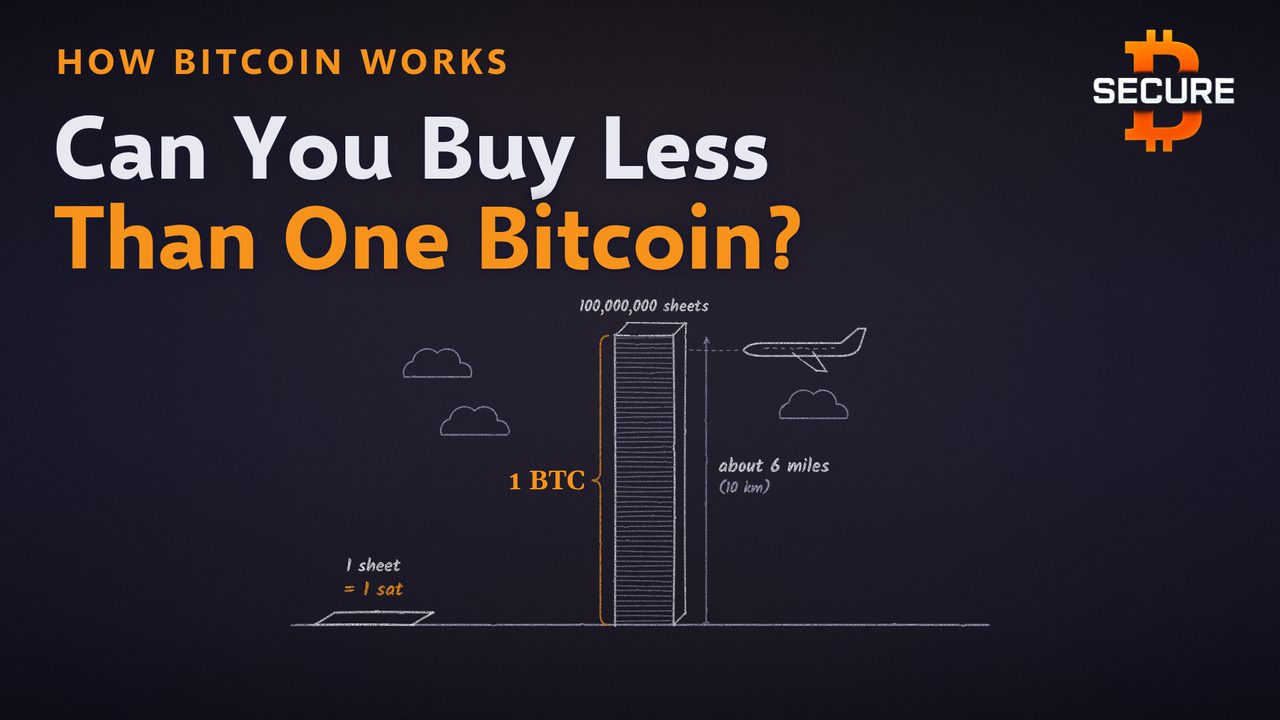
A satoshi, usually shortened to "sat," is the smallest unit of bitcoin: one hundred-millionth of a single coin, written 0.00000001 BTC. One bitcoin is exactly 100,000,000 satoshis.
This is not a convention layered on top by apps or exchanges. It is how Bitcoin itself keeps score. The software does not record balances in bitcoin at all; it records whole numbers of satoshis, and "one bitcoin" is defined in its source code as 100,000,000 of them.1 Bitcoin's creator settled that figure before the network ever launched.2
The dollar works the same way with fewer pieces. A dollar is 100 cents, and nobody calls a $3 coffee "three hundredths of a hundred-dollar bill." A bitcoin simply has a million times more subdivisions than a dollar has cents.
What the Numbers Look Like
To make it concrete, take a round illustrative price of $100,000 per bitcoin. (The real price moves every minute, often sharply, so treat this as arithmetic, not a quote.)
| Amount in dollars | Amount in bitcoin | Amount in satoshis |
|---|---|---|
| $0.001 (a tenth of a cent) | 0.00000001 | 1 |
| $1 | 0.00001 | 1,000 |
| $10 | 0.0001 | 10,000 |
| $100 | 0.001 | 100,000 |
| $100,000 | 1 | 100,000,000 |
Look at the middle rows. Written in bitcoin, $10 is a string of zeros after a decimal point, and it feels like nothing. Written in satoshis, it is ten thousand of something. The amount is identical. Only the unit changed, and the unit changes how it feels.
A Name Given by the Community
Satoshi Nakamoto, the pseudonymous creator of Bitcoin, never named the unit after himself. In November 2010, a member of the early Bitcoin forum suggested calling one hundredth of a bitcoin a "satoshi." A few months later the same person proposed the name for the smallest unit instead, the hundred-millionth. That version caught on and became the standard.2 It was a tribute from the people using the network to someone who had already begun to step away from it.
Why the Price Per Coin Misleads
Economists have a name for the instinct the evening news triggers: unit bias. People tend to treat one of something as the natural amount to own, and to feel that a fraction of a thing is somehow worth less than a whole one of something else. It is why a stock that splits ten-for-one can attract new buyers even though nothing about the company changed.
Unit bias pushes beginners in two bad directions. Some decide Bitcoin is out of reach because one coin costs too much. Others go looking for a token that costs a fraction of a penny, so they can own millions of "coins," without noticing that the price of a single unit says nothing about whether the thing is sound. A million coins of something that can be printed without limit is not a better deal than a few thousand sats of something that cannot. The difference between Bitcoin and other tokens matters far more than the sticker price of one unit.
Small Amounts, Honestly
There is one practical caveat. Moving bitcoin on its main network costs a transaction fee, and when the network is busy that fee can be larger than a very small balance is worth. Holding tiny amounts is fine; moving them one at a time can be costly. That is one of the details the course covers before anyone sets up a wallet.
And the standard caution applies to sats as much as to whole coins: Bitcoin's price is volatile in dollar terms. Ten thousand sats can buy more or less next year than they do today. What does not change is the count. Ten thousand sats remain ten thousand sats, and the total number that will ever exist is fixed.
"One who is faithful in a very little is also faithful in much."
Luke 16:10
Jesus was speaking about character, not currency, but the principle carries over to anyone learning to steward money well. Understanding comes before amount, and small, careful steps teach more than a large leap. Why the unit you save in matters at all is the subject of the free first lesson.
Sources
- Bitcoin Core source code, consensus/amount.h, which defines one coin as 100,000,000 base units.
- Bitcoin Wiki, "Satoshi (unit)": the 100,000,000 subdivision was set by Satoshi Nakamoto no later than November 2008; the forum proposals of November 2010 and early 2011 that named the unit.