
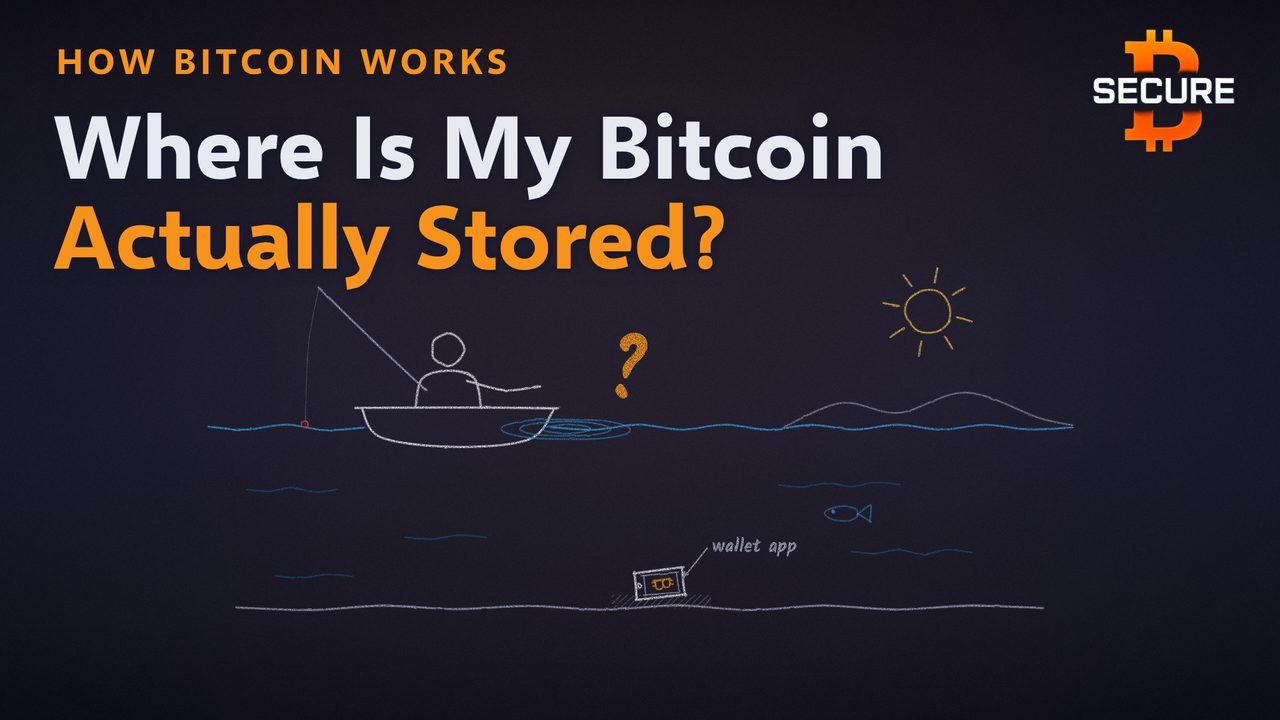
On the morning of November 8, 2022, more than a million people opened an app called FTX and saw their balances exactly where they had left them. The numbers were all there. The withdraw button did nothing. Three days later the company filed for bankruptcy with roughly $8 billion in customer funds missing, and its founder was later sentenced to 25 years in prison.1
Those customers had bought bitcoin. What they held was a number on a company's screen, and a claim against that company if things went wrong. The difference between those two things is the most practical lesson in all of Bitcoin.
What a Key Actually Is
Bitcoin does not sit in a wallet the way cash sits in a pocket. Every coin is recorded on a public ledger, and what you hold is the secret that lets you move it. That secret is called a private key. Whoever knows the key can spend the coins. Nobody who lacks it can, including banks, governments, and the people who maintain the software.
When you buy bitcoin on an exchange and leave it there, the exchange holds the keys. You have an account balance, much like a bank deposit, except without deposit insurance. If the company is hacked, mismanaged, frozen by a court, or simply dishonest, your balance is a line in a bankruptcy filing. Bitcoiners have a blunt phrase for this: not your keys, not your coins.
Holding your own keys is called self-custody. It removes the company from the middle. It also moves the full responsibility onto you, and both halves of that sentence deserve equal weight.
The Seed Phrase: Twelve or Twenty-Four Words
You will never need to look at a raw key. Modern wallets generate a seed phrase instead: a list of 12 or 24 ordinary English words, produced by a published standard that nearly every wallet follows.2 Those words are the master backup for every key the wallet will ever create.
That has two consequences worth reading twice. If your phone or device is lost, broken, or stolen, the words alone can restore everything on a new one. And anyone who sees the words can take everything, from anywhere in the world, usually with nothing else required and no way to reverse it.
Two Kinds of Wallet
A software wallet is an app on your phone or computer. It is free and convenient, and it is a reasonable place for small amounts you intend to spend. Its weakness is that the keys live on a device that is connected to the internet all day.
A hardware wallet is a small dedicated device that creates and stores the keys offline. When you want to send bitcoin, the device signs the transaction internally and the keys never touch your computer. For savings you intend to hold for years, this is the standard approach. The course's resources page lists options along with the criteria used to choose them, as a starting point for your own research.
The One Rule That Prevents Most Losses
Self-custody rarely fails because of sophisticated hacking. It fails in ordinary ways: a seed phrase typed into a fake support website, stored in a photo that syncs to the cloud, or kept in a single copy that a flood destroys. One rule covers the most common of these. No legitimate company, support agent, or app will ever ask for your seed phrase. Anyone who does is trying to steal from you.
The setup itself, done properly, has more to it than a list of tips: choosing a device, creating and storing the backup, proving the backup works before real money depends on it, recognizing the scams aimed at new holders, and making sure your family can reach your bitcoin if you cannot. That is what Lesson 6 of the course walks through, one step at a time.
Is It Worth the Trouble?
Self-custody is not free of risk. It trades one kind for another: the risk that a company fails you for the risk that you fail yourself. There is no customer service line and no reset button. Lose the seed phrase and the coins are gone for good.
For a small amount you are still learning with, leaving it on a reputable exchange for a while is a reasonable choice. As the amount grows into something you would truly miss, the balance shifts. Go slowly, and learn the setup properly before you rely on it.
"The prudent sees danger and hides himself, but the simple go on and suffer for it."
Proverbs 22:3
The FTX customers were not foolish. They trusted a company that looked safer than its rivals. What they lacked was the one thing Bitcoin was built to make possible: the ability to hold their own money without asking anyone's permission. The free first lesson of the course explains why that ability matters in the first place.
Sources
- US Attorney's Office, Southern District of New York, "Samuel Bankman-Fried Sentenced to 25 Years," March 28, 2024. FTX halted withdrawals on November 8, 2022 and filed for bankruptcy on November 11.
- Bitcoin Improvement Proposal 39, "Mnemonic code for generating deterministic keys". See also Bitcoin.org, "Securing your wallet".